
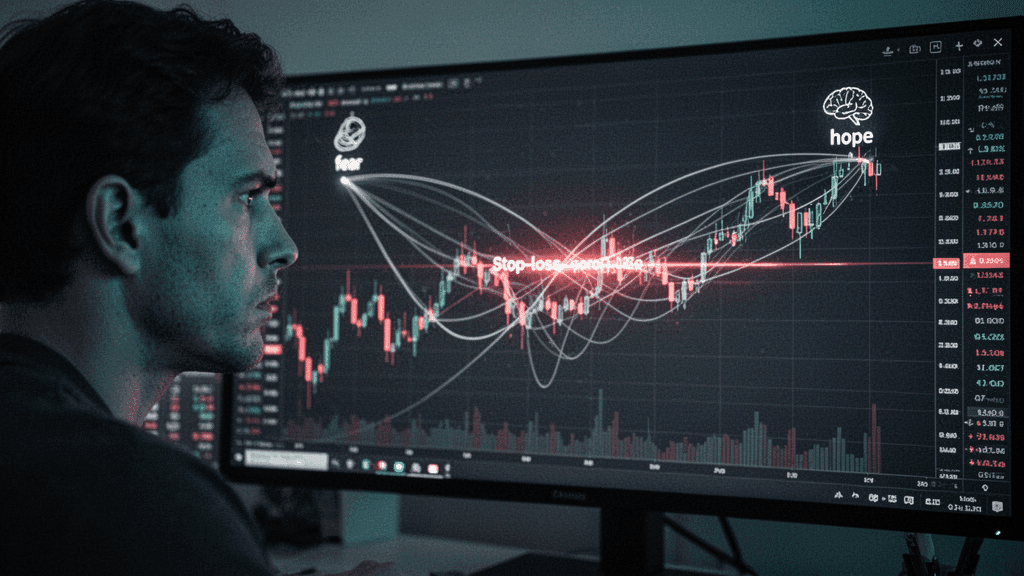
Losses are unavoidable in trading. Confusion doesn’t have to be.
Every trader takes losses. Professionals expect them. Beginners fear them. But there’s a third category that quietly destroys progress — losses that are accepted without understanding.
When a trader shrugs and says, “That loss just happened,” something important is missing.
If you can’t explain a loss clearly, you didn’t learn from it — you only survived it.
The Difference Between Taking a Loss and Processing One
Closing a losing trade is easy. Processing it is not.
Many traders confuse emotional recovery with learning. Once the frustration fades, they assume the lesson has been absorbed. But emotional relief is not insight.
A processed loss answers specific questions. An unprocessed one leaves vague conclusions like:
- “The setup failed”
- “The market was choppy”
- “It just didn’t work today”
These statements feel reasonable, but they are operationally useless.
Learning begins where vague explanations end.
Why Traders Struggle to Explain Losses
Explaining a loss forces precision. Precision forces honesty.
That’s uncomfortable.
Most unexplained losses fall into one of these categories:
- The trade didn’t follow a clear plan
- The rules were bent mid-trade
- The setup was not clearly defined
- The risk was poorly understood
Admitting this feels like admitting incompetence. So traders default to surface-level reasons instead of structural ones.
TradeLyser is built to reduce this ambiguity by tying each loss to context — strategy, execution, and behavior — so explanations become clearer over time.
A Loss Without Explanation Is Noise
Markets produce noise constantly. If you don’t filter it, you absorb randomness instead of information.
A loss only becomes useful when you can place it into one of three buckets:
- A valid loss within a profitable strategy
- A loss caused by execution error
- A loss caused by a flawed assumption
Each bucket demands a different response.
Without this classification, traders make the same mistake repeatedly — changing strategies when the problem was execution, or doubling down when the strategy itself was weak.
Misdiagnosed losses lead to misguided changes.
Why “It Was a Good Loss” Is Not Enough
Some traders pride themselves on accepting losses gracefully. That’s healthy — but incomplete.
Calling something a “good loss” without explanation is still a missed opportunity.
A genuinely good loss can be explained clearly:
- The setup was valid
- Risk was predefined
- Rules were followed
- Outcome was within expectations
If you can’t articulate these points, you don’t know whether the loss was good — you’re just hoping it was.
TradeLyser encourages this clarity by structuring post-trade reflection around decision quality, not emotional comfort.
How Journaling Turns Losses Into Usable Data
Journaling doesn’t eliminate losses. It transforms them.
A properly journaled loss becomes a reference point instead of a regret.
Effective loss journaling focuses on:
- What was expected vs what occurred
- Which assumptions were valid
- Which signals failed or were misread
- Whether the loss was avoidable or acceptable
Over time, patterns emerge. Certain losses repeat. Others disappear. That’s learning in motion.
Losses don’t hurt when they teach — they hurt when they confuse.
The Cost of Moving On Too Quickly
Many traders rush past losses to protect confidence. But speed is the enemy of insight.
Unexamined losses pile up quietly. They don’t scream. They whisper — through hesitation, second-guessing, and loss of conviction.
Eventually, traders stop trusting their judgment, not because they are incapable, but because they never clarified what went wrong.
TradeLyser’s structured review and analytics help slow this process down just enough to extract meaning before the next trade.
Clarity Is the Real Skill Being Built
Trading skill is not about predicting markets. It’s about understanding decisions.
A trader who can clearly explain losses is building something far more valuable than a win rate — they’re building internal consistency.
That consistency compounds into confidence that doesn’t break during drawdowns.
Confidence backed by clarity survives volatility.
Closing Thoughts: Don’t Let Losses Stay Vague
Losses are tuition. But tuition only pays off when the lesson is understood.
If you can’t explain a loss clearly, it will quietly repeat — not because the market is unfair, but because the feedback loop is broken.
TradeLyser exists to turn losses from emotional events into structured insight.
Slow down. Ask better questions. Demand clear answers from every loss.
Because the traders who learn fastest are not the ones who lose least — they are the ones who understand their losses best.