
One red day feels like bad luck. Two red weeks feel like a broken strategy. Putting journal entries side by side replaces those feelings with evidence about what you did differently.
This page covers which five fields to compare, how to read a good-process day against a bad-process day, how to spot the discipline pattern across weeks, and how to run the comparison in TradeLyser.
Why compare entries instead of scrolling trades
The trade log tells you what happened: Bank Nifty lost ₹12,000 on Monday. The journal entry tells you why: you doubled size after the first stop and your note said "need to recover before close". Only the second version gives you something to fix.
Comparison makes the why visible. One bad day looks like a one-off. The same tag on four bad days across a month is a habit, and a habit can be written into a rule.
Session timing is a common hidden difference on the NSE. If your losing days cluster between 11:00 and 13:30 while your winning days are mostly finished by 10:30, the fix is probably a time rule, such as no new entries after 11:00. A new indicator on the 5-minute chart would not touch it.
The five fields to compare
Compare the same fields every time, in the same order, and leave P&L until the end. The examples in the right-hand column are illustrative.
| Field | What to check | A difference that matters |
|---|---|---|
| Setup | Was each trade a written setup, and which one | Day A: four opening range breakouts. Day B: two breakouts and five untagged scalps. |
| Size | Lots or quantity against the plan | Day B: lot size doubled after the first stop. |
| Time | When the entries happened | Day B: six of seven entries between 11:00 and 13:30. |
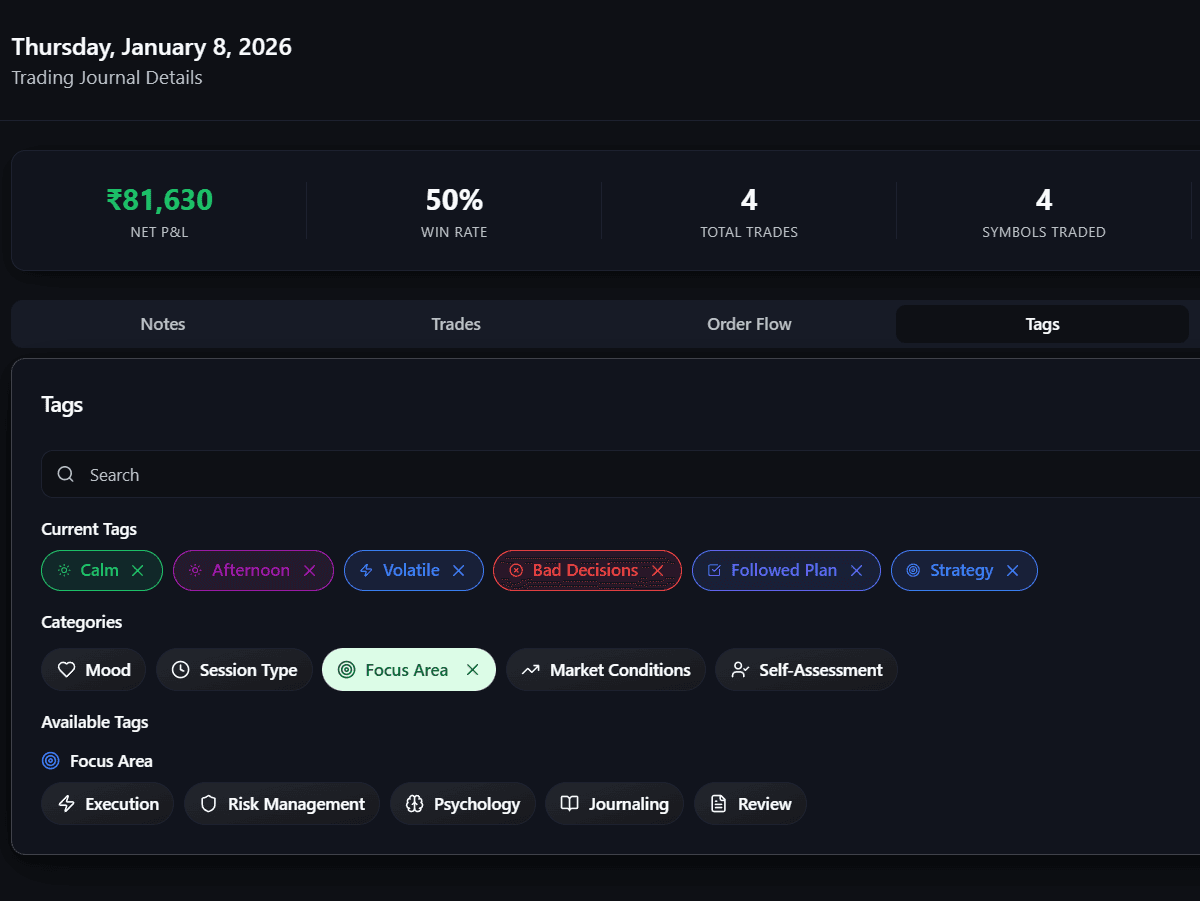
| Mood | Mood and self-assessment tags for the day | Day A: Calm, Followed Plan. Day B: Bad Decisions. |
| Rule adherence | Trades within every rule, out of total trades | Day A: 4 of 4. Day B: 3 of 7. |
Tags make this work. A small fixed set you can filter (setup name, mistake type, mood, market condition) compares well. Long paragraphs do not, because nobody rereads twelve of them to find a pattern.
A good-process day against a bad-process day
Here is an illustrative pair of Nifty and Bank Nifty days from the same week. Sorted by P&L, the second day wins. Sorted by process, it is the one to worry about.
Good-process day
Bad-process day
The red day cost the planned risk and nothing more. The green day made money with habits that, repeated at size, produce the kind of loss that takes weeks to recover. The comparison sentence for this pair writes itself: "Day B differed because I kept trading after the plan window and added size after a stop."
Measure losses against planned risk where you can. ₹8,000 lost on a planned one-R Bank Nifty stop is a clean loss. The same ₹8,000 lost on a third unplanned Nifty scalp is a discipline failure, and the journal entry should say which of the two it was.
Compare weeks to see the discipline pattern
Single days are noisy. Line up several weeks with their rule adherence and the pattern is easier to trust.
In this example every week at 88% adherence or higher was green, and the three weeks at 70% or lower (61%, 70% and 55%) were all red. Comparing week 7 (55%, −₹15k) with week 8 (93%, +₹12k) tells you more than reading either one alone: same trader, same market month, different behaviour.
The comparison also works the other way. If adherence stays high and P&L still turns red for several weeks, look at whether the setup still suits current conditions, and trade smaller while you check. If adherence is low and P&L is green, treat the profit as borrowed. The same habits at a larger size are how a good month turns into a bad quarter.
Comparing two days in TradeLyser
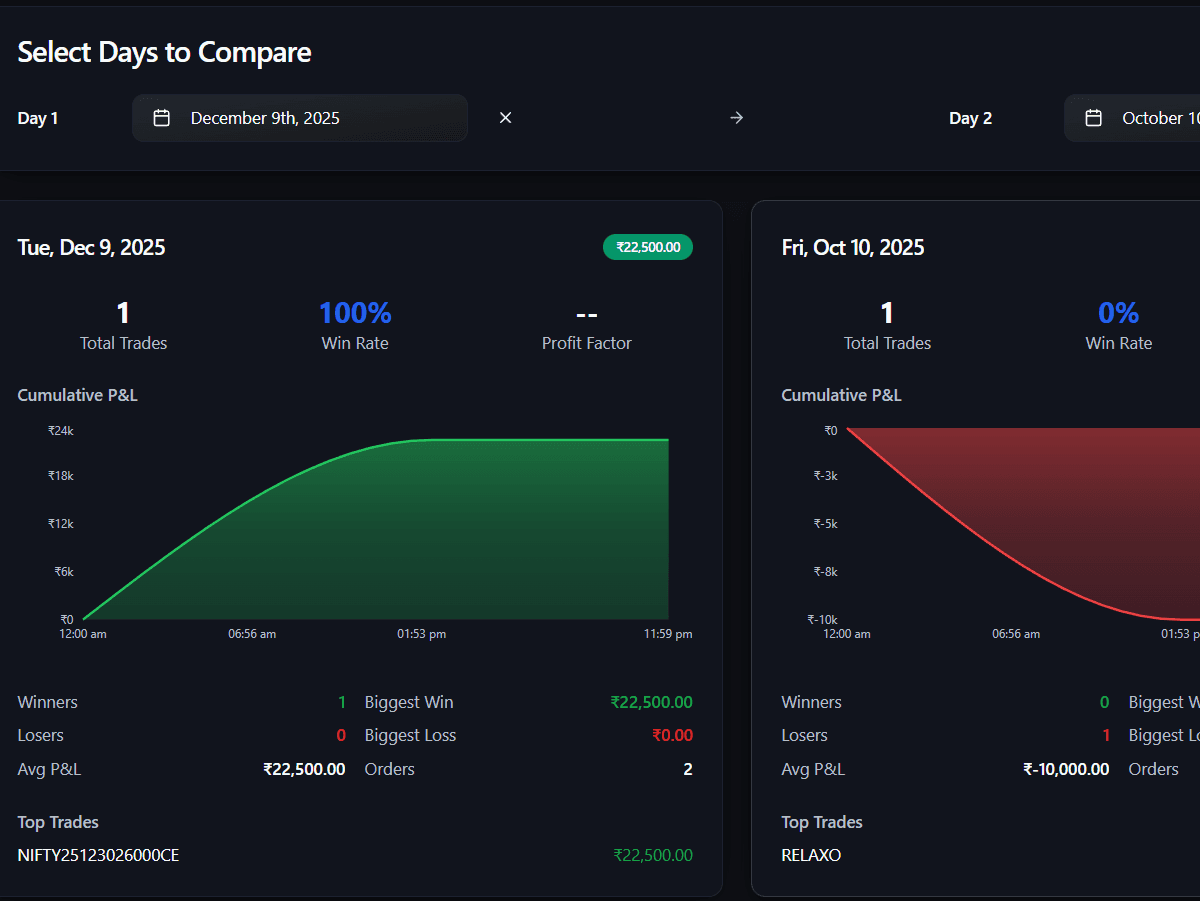
- Pick the two days: usually your worst day of the week and a recent day with a similar setup that went to plan.
- Open them in the compare view and read trade count, win rate and profit factor for each.
- Look at the cumulative P&L lines. Note where the bad day turned, and what time it was.
- Open each day's tags and notes and fill in the five fields: setup, size, time, mood, rule adherence.
- Write one sentence that starts "Day B differed because…" and one fix for the next session.
Twenty minutes a week is enough. Keep each week's sentence in a single running note, and after a couple of months you will have a short record of your own repeated mistakes.
Comparison mistakes to avoid
- Comparing P&L colour only, without looking at rule adherence.
- Picking the two days that support a story you already believe.
- Blending Nifty and Bank Nifty trades when your process differs between them.
- Changing three rules after one comparison.
- Skipping the comparison on green weeks, when rule breaks are easiest to miss.
Questions traders ask
How do I compare two days in my trading journal?
Put the two days side by side and compare the same fields for each: setups taken, position size, entry times, mood tags and how many trades followed every rule. Look at P&L last, then write one sentence on what was different.
Should I compare my green trading days with my red ones?
Yes, but use the same checklist for both. Rule breaks often hide on green days, and a red day with clean execution may only reflect a market that did not suit your setups.
What should a journal entry include so it can be compared later?
A setup tag on every trade, a mood or self-assessment tag for the day, and a short note on anything unusual. Short, consistent tags compare far better than long free-text notes.