
Derivatives Glossary
Futures and options on NSE: contracts, Greeks, volatility, multi-leg structures, settlement and margin.
About derivatives terms
Derivatives terms cover futures and options on NSE. The basics are calls and puts, strike, premium, and intrinsic and time value. Then come the Greeks (delta, gamma, theta and vega), implied volatility and IV crush, open interest and the option chain, and multi-leg structures such as spreads, straddles, strangles and iron condors. Another group covers settlement and margin: SPAN margin, mark-to-market, physical settlement of stock F&O and assignment risk.
The calendar matters in Indian F&O. Nifty weekly options expire every Tuesday, while Bank Nifty and FinNifty have monthly contracts only, expiring on the last Tuesday of the month. From 1 April 2026, STT is 0.15% of the sell-side premium on options and 0.05% of the sell side on futures, so a strategy with a small average gain per trade can turn negative after costs. Tag each position by structure, such as naked, spread or hedge, so win rate and P&L compare like with like. Lot sizes are revised periodically, so check the current NSE circular.
Key terms in this category
Start with these, then use the full list below.
- In-depthCall OptionA call option gives the buyer the right, but not the obligation, to buy the underlying at a fixed strike price; NSE index and stock options…Call buyer P&L at expiry = (max(Expiry price − Strike, 0) − Premium) × Lot size × Lots
- In-depthPut OptionA put option gives the buyer the right, but not the obligation, to sell the underlying at a fixed strike price, exercisable only at expiry…Put buyer P&L at expiry = (max(Strike − Expiry price, 0) − Premium) × Lot size × Lots
- In-depthThetaTheta is the amount an option’s premium is expected to lose from one day passing, with the underlying price and implied volatility…Premium change from time ≈ Theta × Days passed (other factors unchanged)
- In-depthImplied VolatilityImplied volatility (IV) is the annualised volatility that, put into an option pricing model, gives the option’s current market price.Expected 1-SD move ≈ Spot × IV × √(Days ÷ 365)
- In-depthOpen InterestOpen interest (OI) is the number of derivative contracts that have been opened and not yet closed, offset or settled.
- In-depthExpiry Day TradingExpiry day trading means opening or managing F&O positions on the last session of a contract, when time value runs out within hours and…
All 59 derivatives terms
- BackwardationBackwardation is when a futures price trades below the spot price, or a nearer expiry trades above a later one, so the price curve slopes down.
- Basis (Futures vs Spot)Basis is the gap between a futures price and the spot price of the same underlying, usually quoted in India as futures minus spot.
- Butterfly SpreadA butterfly spread uses three strikes in one expiry: buy one lower strike, sell two middle strikes and buy one higher strike, so the profit peaks at the middle strike…
- Calendar SpreadA calendar spread buys and sells options (or futures) on the same underlying and strike but with different expiries; the usual long calendar sells the nearer expiry and…
- Call OptionA call option gives the buyer the right, but not the obligation, to buy the underlying at a fixed strike price; NSE index and stock options are European-style, so that…
- Cash Secured PutA cash-secured put is selling a put option while keeping enough cash aside to buy the shares at the strike if the put ends in the money.
- Cash SettlementCash settlement closes a derivative at expiry by paying the difference between the settlement price and the contract price in money, with no shares changing hands.
- ContangoContango is when futures trade above the spot price and later expiries above nearer ones, so the price curve slopes upward.
- Covered CallA covered call is owning shares and selling a call option on them, collecting premium in exchange for giving up gains above the strike.
- Credit SpreadA credit spread sells one option and buys a further out-of-the-money option of the same type and expiry, so you receive a net premium and the bought leg caps the loss.
- Debit SpreadA debit spread buys one option and sells a cheaper option of the same type and expiry at a different strike, so you pay a net premium (the debit) and both your maximum…
- DeltaDelta estimates how much an option’s premium changes for a 1-point move in the underlying: between 0 and 1 for calls and between 0 and −1 for puts.
- Delta NeutralA position is delta neutral when the deltas of all its legs add up to roughly zero, so a small move in the underlying barely changes its value.
- ExpirationExpiration is the last trading day of a futures or options contract, after which it is settled and stops existing.
- Expiry Day TradingExpiry day trading means opening or managing F&O positions on the last session of a contract, when time value runs out within hours and at-the-money options swing…
- Funding RateA funding rate is a periodic payment between the long and short holders of a perpetual futures contract, used mostly in crypto markets to keep the contract’s price close…
- Futures ContractA futures contract is an exchange-traded agreement to buy or sell an underlying at a set price on a future date, with gains and losses settled every day through…
- GammaGamma measures how much an option’s delta changes for a 1-point move in the underlying, so it tells you how quickly your directional exposure shifts.
- Gamma SqueezeA gamma squeeze is a sharp move driven partly by option sellers hedging: dealers who are short calls buy the underlying as it rises, because their delta grows, and that…
- Greeks (Options)The Greeks are the measures of how an option’s price responds to each thing that moves it: delta to the underlying price, gamma to the change in delta, theta to time…
- Implied VolatilityImplied volatility (IV) is the annualised volatility that, put into an option pricing model, gives the option’s current market price.
- In The Money (ITM)An option is in the money (ITM) when it has intrinsic value: a call whose strike is below the current price, or a put whose strike is above it.
- Index Futures (Nifty / Bank Nifty)Index futures are exchange-traded contracts to buy or sell an index such as Nifty 50 at a set price on a future date, settled in cash because an index cannot be…
- Intrinsic ValueIntrinsic value is the amount by which an option is in the money: the part of its premium that would be paid out if it settled right now.
- Iron ButterflyAn iron butterfly sells an at-the-money call and put at the same strike and buys a further out-of-the-money call and put as wings, so the credit is large but the profit…
- Iron CondorAn iron condor sells an out-of-the-money put spread and an out-of-the-money call spread on the same expiry, and keeps the whole net credit if the price stays between the…
- IV CrushIV crush is a sharp fall in an option’s implied volatility once an expected event, such as quarterly results, the Union Budget or an RBI policy decision, is out of the…
- MarginMargin is the money, and approved collateral, that your broker must collect upfront before you can hold a futures position or sell an option, sized by the exchange to…
- Mark to Market (MTM)Mark to market (MTM) is the daily revaluation of open futures positions at the exchange’s settlement price, with the day’s gain credited to, or loss debited from, your…
- Max PainMax pain is the expiry price at which the options open on a contract would pay out the least to their holders in total, worked out from the open interest at every strike.
- Open InterestOpen interest (OI) is the number of derivative contracts that have been opened and not yet closed, offset or settled.
- Open Interest ChangeOI change is how much open interest in a contract has risen or fallen since the previous session, showing whether positions are being opened or closed overall.
- Option ChainAn option chain is the table of all strikes for one underlying and expiry, with calls on one side, puts on the other, and the premium, OI, volume and IV for each.
- Options FlowOptions flow is the stream of option trades in an underlying, read for size, strike, expiry and whether buyers or sellers were the aggressive side, to see where large…
- Out Of The Money (OTM)An option is out of the money (OTM) when exercising it now would be worth nothing: a call whose strike is above the spot price, or a put whose strike is below it.
- Perpetual FuturesA perpetual future is a futures contract with no expiry date, traded mainly on crypto exchanges, that stays close to the spot price through periodic funding payments…
- Physical SettlementPhysical settlement means a derivatives position open at expiry is settled by actual delivery of the underlying shares rather than by a cash difference.
- PremiumAn option’s premium is the price the buyer pays and the seller receives for the contract, quoted per unit of the underlying.
- Protective PutA protective put is a put option bought against shares or futures you already hold, so losses below the put’s strike are offset while gains above it are kept, minus the…
- Put OptionA put option gives the buyer the right, but not the obligation, to sell the underlying at a fixed strike price, exercisable only at expiry for NSE index and stock…
- Put/Call RatioThe put-call ratio (PCR) divides put open interest (or put volume) by call open interest (or call volume) for an underlying, as a rough gauge of which way options…
- SettlementSettlement is the step that completes a trade: money and securities actually change hands through the clearing corporation, or a derivatives position is closed out with…
- SPAN MarginSPAN margin is the part of the initial margin on an F&O position that NSE Clearing works out by testing the whole portfolio against a set of price and volatility…
- StraddleA straddle is buying (long) or selling (short) a call and a put at the same strike and expiry, usually at the money, to trade the size of a move rather than its…
- StrangleA strangle combines an out-of-the-money call and an out-of-the-money put on the same underlying and expiry.
- Strike PriceThe strike price is the fixed price at which an option buyer can buy (call) or sell (put) the underlying at expiry.
- Synthetic PositionA synthetic position combines options, or options with futures, so that the payoff copies another instrument.
- ThetaTheta is the amount an option’s premium is expected to lose from one day passing, with the underlying price and implied volatility unchanged.
- Theta DecayThe theta decay curve shows how an option’s time value shrinks as expiry approaches, with the underlying and implied volatility held still.
- Time ValueTime value is the part of an option’s premium above its intrinsic value: what the buyer pays for the chance of a further move before expiry.
- VegaVega estimates how much an option’s premium changes when implied volatility (IV) moves by one percentage point, with price and time unchanged.
- Vertical SpreadA vertical spread buys one option and sells another of the same type and expiry at a different strike, which caps both the profit and the loss.
Spotting expiry-day patterns
The trading calendar shows P&L and trade count for each day of the month, so a run of red expiry days stands out at a glance.
See journaling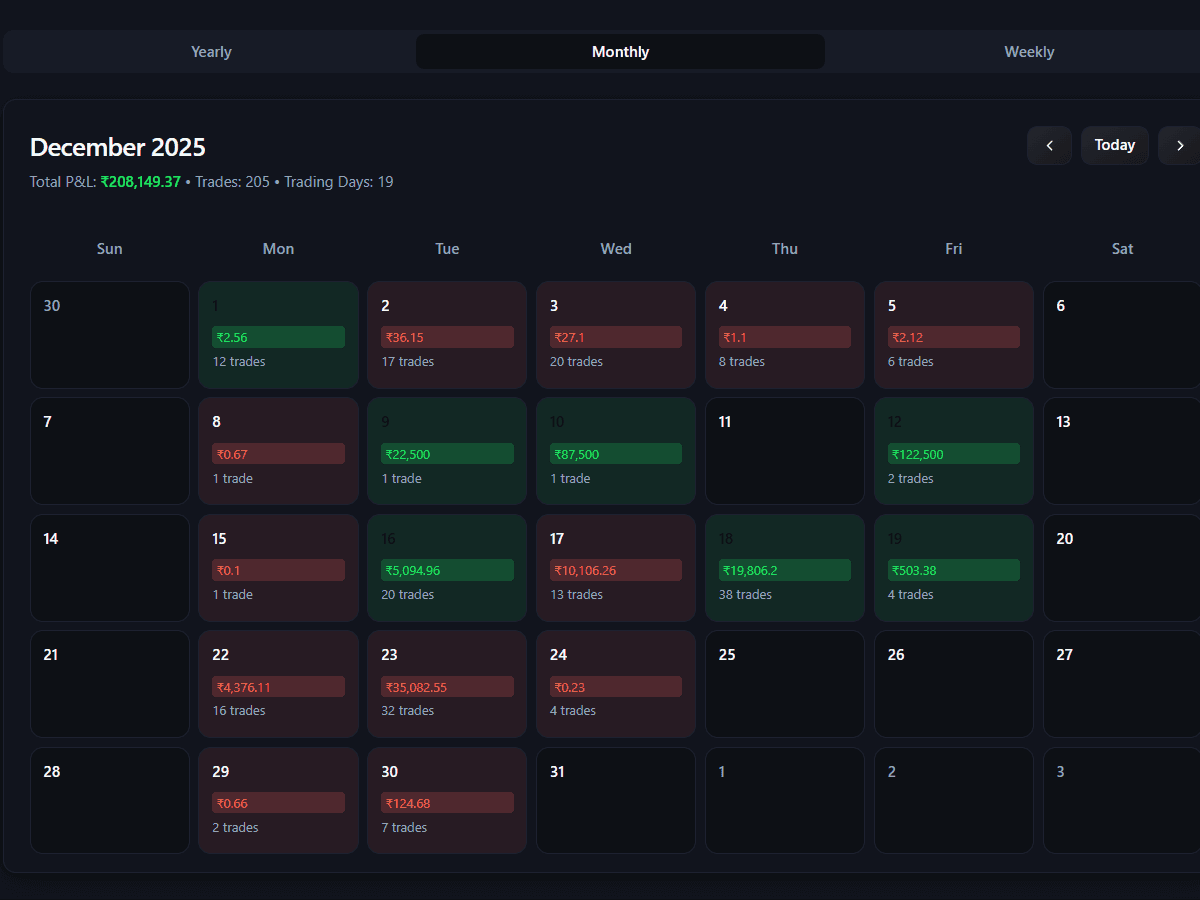
Guides and tools for derivatives
- GuideHow to keep a trading journal for NSE F&OWhat an options and futures trading journal in India should record: contract, lots, MIS or NRML, planned risk and net P&L after STT, plus expiry-day tags.
- GuideUsing a trading calendar for performance reviewUse a trading calendar in performance review to spot losses that cluster on expiry days, event days or after a losing streak, then set one rule for them.
- GuideHow to analyze win rate without fooling yourselfWhy win rate means little without payoff and sample size, how to work out your breakeven win rate, and how to split it by strategy, tag and session.
- Free toolOptions Greeks calculatorDelta, gamma, theta and vega for a strike.
- Free toolTheta decay simulatorHow premium decays as expiry gets closer.
- Free templateNSE F&O options journalA template for logging options trades by structure.
Other categories
All 370 terms, A to Z →Track it on your own trades
Connect your Indian broker and review every trade with tags, notes and per-strategy numbers.