
Risk Management Glossary
How much you can lose before a trade starts, and the ways a loss grows beyond the plan.
About risk management terms
Risk management terms decide how much you can lose before a trade starts. Position sizing and risk per trade set the rupee loss if the stop is hit. Stop-loss, trailing stop and risk-reward setup fix where you get out. Leverage, margin calls and overnight gap risk describe how a loss can grow past the plan, and value at risk and risk of ruin put a number on how bad a losing run could get.
A common approach is to risk a fixed share of capital on each trade, often somewhere between 0.5% and 2%, and size every position from the distance to the stop. On ₹5,00,000 with 1% risk, that is ₹5,000 a trade, whether the trade is a Nifty option or a cash stock. Write the limits down before the session and check in your journal that you kept them, because a green week built on oversized positions is still a broken rule. This category is small on purpose: drawdown, R-multiple and risk of ruin as a metric sit under Metrics.
Key terms in this category
Start with these, then use the full list below.
- In-depthPosition SizingPosition sizing is deciding how many shares or lots to trade so that hitting your stop costs a fixed, pre-planned amount.Lots = Risk per trade ÷ (Stop distance × Lot size), rounded down
- In-depthRisk Per TradeRisk per trade is the amount you would lose if a trade hits its stop-loss, decided before entry as a rupee amount or a percentage of…Risk per trade (₹) = (Entry − Stop) × Quantity, for a long trade; Risk % = Risk ₹ ÷ Trading capital × 100
- In-depthStop LossA stop-loss is a price set in advance at which you exit a losing trade, so the loss stays close to a size you chose before entry.Planned loss = (Entry − Stop) × Quantity, for a long trade
- In-depthTrailing StopA trailing stop is a stop-loss that follows the price as it moves in your favour and never moves back.Trailing stop (long) = Highest price since entry − Trail distance; it only moves up
- In-depthRisk-Reward SetupA risk-reward setup is the full plan for a trade written before entry: the entry price, the stop-loss that proves the idea wrong, the…Reward : risk = (Target − Entry) ÷ (Entry − Stop), for a long trade; Breakeven win rate = 1 ÷ (1 + Reward : risk)
- In-depthLeverageLeverage is the size of your market exposure compared with the capital behind it.Leverage = Notional exposure ÷ Trading capital; for options, exposure ≈ Delta × Quantity × Underlying price
All 11 risk management terms
- Risk Per TradeRisk per trade is the amount you would lose if a trade hits its stop-loss, decided before entry as a rupee amount or a percentage of trading capital.
- Risk-Reward SetupA risk-reward setup is the full plan for a trade written before entry: the entry price, the stop-loss that proves the idea wrong, the target, and the ratio of possible…
Writing limits down and checking them
Rules hold limits such as a net max loss per day or per trade and a maximum number of trades per day, and show how often each one was followed.
See journaling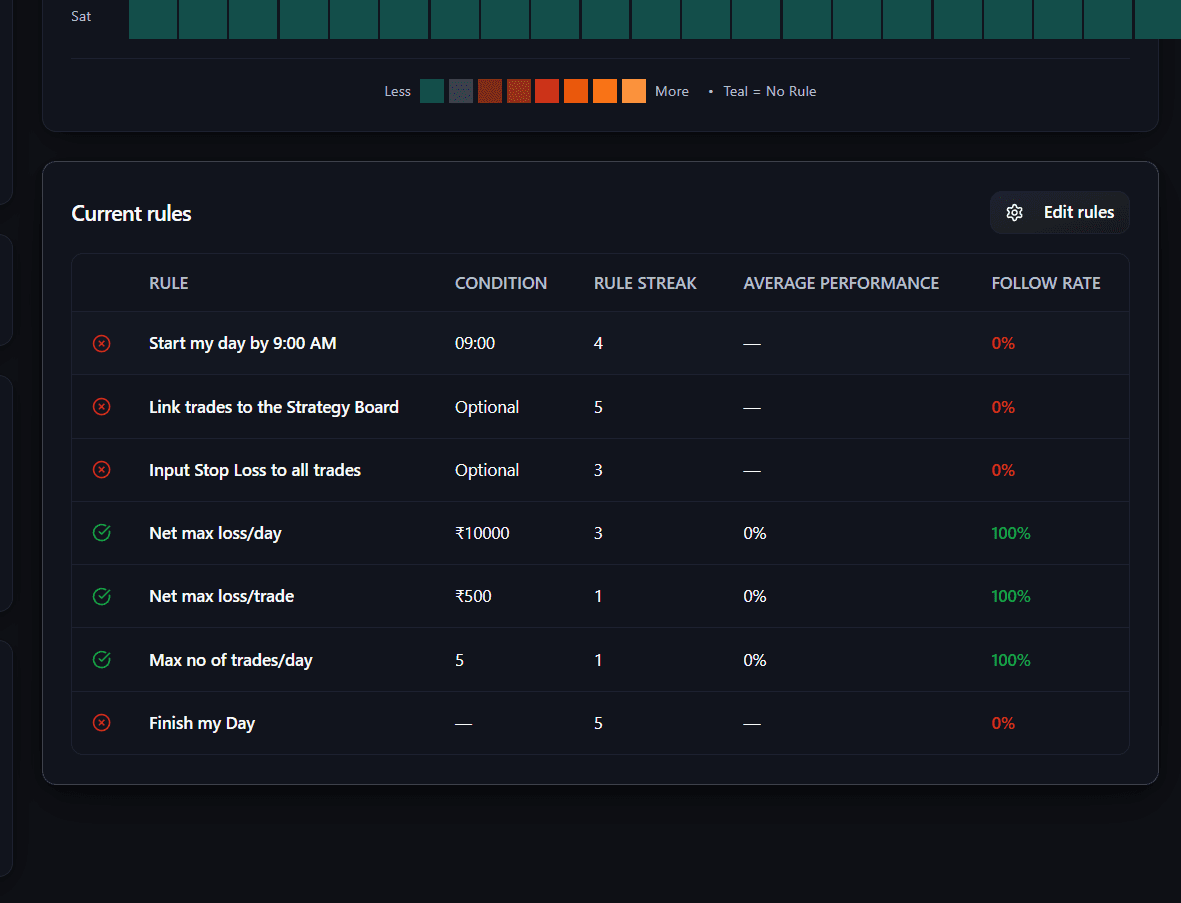
Guides and tools for risk management
- GuideHow to Read Your Equity Curve and Set Drawdown LimitsRead your equity curve per strategy, set drawdown limits before you need them, and know when to cut size or pause. With an NSE options example.
- GuideHow to track your trading discipline scoreTrack a trading discipline score that rates rule adherence, not outcomes. Write rules you can score, log them in minutes and read them next to weekly P&L.
- GuideHow to keep a trading journal for NSE F&OWhat an options and futures trading journal in India should record: contract, lots, MIS or NRML, planned risk and net P&L after STT, plus expiry-day tags.
- Free toolPosition sizing calculatorShares or lots from your risk per trade and stop distance.
- Free toolRisk-reward calculatorCheck a trade plan before you place it.
- MethodologyTrading rulesHow written limits are tracked against real trades.
Other categories
All 370 terms, A to Z →Track it on your own trades
Connect your Indian broker and review every trade with tags, notes and per-strategy numbers.