
Technical Analysis Glossary
Indicators, candle patterns and price structure, defined the way they are read on Nifty, Bank Nifty and liquid NSE stocks.
About technical analysis terms
Technical analysis terms describe what price and volume did on a chart. Some are indicators, such as RSI, MACD, VWAP and ATR. Some are candle patterns, such as the hammer, doji and engulfing pattern. The rest describe structure: support, resistance, trendlines, breakouts and volume profile. Each definition says what the term measures and how it is commonly read on Nifty, Bank Nifty and liquid NSE stocks.
In a journal these words become setup tags, and a tag only helps if it means one thing. "Breakout" should name a written rule, for example a close above the previous day's high on above-average volume, rather than any trade that went up. Keep indicator settings fixed within a tag, because RSI(14) on a 5-minute chart and RSI(14) on a daily chart are different signals. Once each tag has a few dozen trades, compare expectancy across tags to see which setups pay after costs.
Key terms in this category
Start with these, then use the full list below.
- In-depthVWAPVWAP (volume-weighted average price) is the average price traded so far in the session, with each price weighted by the volume traded at it.VWAP = Σ (Typical price × Volume) ÷ Σ Volume, where typical price = (High + Low + Close) ÷ 3 for each bar, reset at the session open
- In-depthRSI (Relative Strength Index)The Relative Strength Index (RSI) is a momentum oscillator, developed by J.RSI = 100 − 100 ÷ (1 + RS), where RS = Average gain ÷ Average loss over 14 periods, smoothed by Wilder’s method
- In-depthMoving AverageA moving average is the average closing price over the last N bars, recalculated as each new bar closes, which smooths out day-to-day noise…SMA = Sum of the last N closes ÷ N; EMA today = Close × k + EMA yesterday × (1 − k), where k = 2 ÷ (N + 1)
- In-depthSupportSupport is a price area where falling prices have repeatedly stopped and turned up, because buyers stepped in there before.
- In-depthBreakoutA breakout is a move in which price closes beyond a level that has capped it, such as a range high, a pattern boundary or the prior day’s…Long breakout risk = Entry − Stop; Measured-move target = Breakout level + Range height
All 82 technical analysis terms
- Accumulation/Distribution (A/D)The accumulation/distribution (A/D) line is a running total of volume, weighted by where each bar closes inside its own high-low range.
- ADX (Average Directional Index)The Average Directional Index (ADX) measures how strong a trend is on a 0 to 100 scale, without saying whether it is up or down.
- ATRAverage True Range (ATR) is the average size of a bar’s full price movement, including any gap from the previous close, over a set number of bars (14 by default).
- Bollinger BandsBollinger Bands draw an upper and lower line a set number of standard deviations around a moving average, by default 2 standard deviations around a 20-period simple…
- BreakoutA breakout is a move in which price closes beyond a level that has capped it, such as a range high, a pattern boundary or the prior day’s high, often with a rise in…
- CandlestickA candlestick is a chart bar that shows four prices for one period: open, high, low and close.
- CCI (Commodity Channel Index)The Commodity Channel Index (CCI) measures how far the typical price has moved from its own average, scaled by its average deviation, so readings above +100 or below…
- Chaikin Money FlowChaikin Money Flow (CMF) is the sum of money flow volume over a set period divided by total volume over the same period, giving a reading between −1 and +1.
- ConfluenceConfluence is when several independent reasons for the same trade point to the same price area at the same time, such as a prior-day high, a rising moving average and…
- Cumulative DeltaCumulative delta is the running total of buyer-initiated volume minus seller-initiated volume over a session.
- Cup and HandleA cup and handle is a bullish continuation chart pattern: price falls from a high, builds a rounded base (the cup), climbs back near the old high, then drifts down in a…
- Dark Cloud CoverDark cloud cover is a two-candle bearish reversal pattern: after an advance, a strong up candle is followed by a candle that opens above the prior high and closes below…
- Death CrossA death cross is when a shorter moving average, most often the 50-day simple moving average, crosses below a longer one, most often the 200-day.
- DivergenceDivergence is when price and a momentum indicator such as RSI or MACD move in different directions, for example price making a higher high while the indicator makes a…
- Doji CandlestickA doji is a candle whose open and close are at, or almost at, the same price, so the real body is a thin line and the candle is mostly wicks.
- Donchian ChannelA Donchian channel plots the highest high and the lowest low of the last N bars, with an optional middle line halfway between them; 20 bars is the common default.
- Double BottomA double bottom is a reversal chart pattern in which price falls to a low, rebounds, falls back to roughly the same low and then rises above the peak between the two…
- Double TopA double top is a bearish reversal chart pattern in which price rises to a high, pulls back, rallies to roughly the same high and then falls below the trough between the…
- Elliott Wave TheoryElliott Wave Theory, developed by Ralph Nelson Elliott in the 1930s, describes trending markets as moving in five waves in the direction of the trend followed by three…
- EMA (Exponential Moving Average)An EMA (exponential moving average) is a moving average that gives more weight to recent closes, so it reacts faster to new prices than a simple moving average of the…
- Engulfing PatternAn engulfing pattern is a two-candle reversal pattern in which the second candle’s real body completely covers the first candle’s body and points the other way.
- Evening StarAn evening star is a three-candle bearish reversal pattern that forms after a rise: a long green candle, a small-bodied candle (the star) that opens above it, and a red…
- Fair Value Gap (FVG)A fair value gap (FVG) is a three-candle price zone where the wicks of the first and third candles do not overlap, so only the large middle candle traded through it.
- Fibonacci ExtensionFibonacci extensions are price levels beyond the end of a swing, drawn at ratios such as 61.8%, 100%, 127.2% and 161.8% of that swing, and are mostly used to plan profit…
- Fibonacci RetracementFibonacci retracement marks horizontal levels inside a completed swing at fixed ratios, usually 23.6%, 38.2%, 50%, 61.8% and 78.6%, where traders watch for a pullback to…
- Flag PatternA flag is a short, tight pause that slopes slightly against a sharp move, after which price often continues in the original direction.
- Footprint ChartA footprint chart shows, inside each candle, how much volume traded at each price and whether it traded at the bid (sellers hitting bids) or at the ask (buyers lifting…
- Golden CrossA golden cross is the day a shorter moving average crosses above a longer one, most often the 50-day simple moving average crossing above the 200-day.
- Gravestone DojiA gravestone doji is a candle that opens, trades sharply higher and then closes back at or near its open and its low, leaving a long upper shadow and almost no body.
- Hammer CandlestickA hammer is a single candle after a decline with a small body near the top of its range and a long lower shadow, at least about twice the body.
- Hanging ManA hanging man is a candle with a small body at the top of its range and a long lower shadow that appears after a rise; it has the same shape as a hammer, but its…
- Harami PatternA harami is a two-candle pattern in which a small body sits entirely inside the previous candle’s larger body, showing that a strong move has slowed.
- Harmonic PatternsHarmonic patterns are five-point price structures (X, A, B, C, D) whose swings must fit set Fibonacci ratios, used to mark a zone where a reversal may start.
- Head and ShouldersHead and shoulders is a reversal pattern where price makes a peak (left shoulder), a higher peak (head) and a lower peak (right shoulder), with a neckline joining the…
- Heikin-AshiHeikin-Ashi is a candlestick chart built from averaged prices, so each candle blends the current bar with the previous Heikin-Ashi candle and trends look smoother.
- Higher High Lower LowHigher highs and higher lows describe an uptrend, where each swing peak and each pullback low sits above the previous one; lower highs and lower lows describe a…
- Ichimoku CloudThe Ichimoku cloud (Ichimoku Kinko Hyo) is an indicator with five lines that shows trend direction, momentum and support or resistance zones on one chart, using default…
- Inside BarAn inside bar is a candle whose high and low both sit within the range of the candle before it, called the mother bar, which shows the range contracting for a bar.
- MACDMACD (Moving Average Convergence Divergence) is a momentum indicator equal to the 12-period EMA minus the 26-period EMA, plotted with a 9-period EMA of itself as the…
- Market InternalsMarket internals are measures of what is happening across all the stocks in a market, such as advances versus declines, new highs versus lows and volume flowing into…
- Market Structure Break (MSB)A market structure break (MSB) is when price closes beyond the swing point that defined the current trend, such as falling below the last higher low in an uptrend, which…
- MarubozuA marubozu is a candle with a long body and little or no wick at either end, showing that one side controlled the bar from open to close.
- MFI (Money Flow Index)The Money Flow Index (MFI) is a 0 to 100 oscillator that measures buying and selling pressure from both price and volume, often described as a volume-weighted RSI.
- Morning StarA morning star is a three-candle bullish reversal pattern: a long down candle, a small candle that opens lower, and a strong up candle that closes well into the first…
- Moving AverageA moving average is the average closing price over the last N bars, recalculated as each new bar closes, which smooths out day-to-day noise so the direction of the trend…
- Multi-Timeframe AnalysisMulti-timeframe analysis means reading the same instrument on two or three chart timeframes, using the higher one for direction and key levels and the lower one to time…
- OBV (On-Balance Volume)On-Balance Volume (OBV) is a running total that adds a day’s volume when the close is higher than the previous close and subtracts it when the close is lower.
- OverboughtOverbought describes a market that has risen far and fast enough for a momentum oscillator to sit near the top of its usual range, such as RSI (14) above 70.
- OversoldOversold describes a market that has fallen far and fast enough for a momentum oscillator to sit near the bottom of its usual range, such as RSI (14) below 30.
- Parabolic SARParabolic SAR (stop and reverse) is a trend-following indicator that plots a stop level below price in an uptrend and above it in a downtrend, moving closer to price as…
- Pin BarA pin bar is a single candle with a long wick on one side and a small body at the other end, showing that price was pushed to a level and rejected.
- Pivot PointsPivot points are price levels calculated from the previous session’s high, low and close, used as reference support and resistance for the next session.
- Point of Control (POC)The point of control (POC) is the price level with the most traded volume in a volume profile for a chosen period, such as one session.
- Price ActionPrice action is the practice of making trading decisions from price itself: swing highs and lows, candles, levels and how price behaves around them, with few or no…
- Relative StrengthRelative strength compares how a stock has performed against a benchmark, usually the Nifty 50 or its sector index, over the same period.
- Relative VolumeRelative volume (RVOL) compares how much a stock has traded with how much it normally trades over the same stretch of time.
- Renko ChartA Renko chart draws a fixed-size brick each time price moves a set amount, and ignores time and small moves in between.
- ResistanceResistance is a price area where rallies have repeatedly stalled because selling has outweighed buying there.
- ROC (Rate of Change)Rate of change (ROC) is a momentum indicator that measures the percentage change between today’s close and the close a set number of periods ago.
- RSI (Relative Strength Index)The Relative Strength Index (RSI) is a momentum oscillator, developed by J.
- Shooting StarA shooting star is a single-candle bearish reversal pattern that appears after an advance: a small body near the low of the bar, a long upper shadow at least twice the…
- SMA (Simple Moving Average)A simple moving average (SMA) is the plain average of the last n closing prices, with every close weighted equally, recalculated each bar.
- Spinning TopA spinning top is a candle with a small real body and upper and lower shadows on both sides, showing that neither buyers nor sellers kept control during the bar.
- Stochastic OscillatorThe stochastic oscillator, developed by George Lane, shows where the latest close sits within the high-low range of the last n periods, usually 14, on a 0 to 100 scale.
- Supertrend IndicatorSupertrend is a trend-following indicator that plots one line below price in an uptrend and above price in a downtrend, set a multiple of the Average True Range (ATR)…
- Supply and Demand ZonesSupply and demand zones are price areas where a sharp move began: a demand zone is the base just before a strong rally, a supply zone the base just before a strong fall.
- SupportSupport is a price area where falling prices have repeatedly stopped and turned up, because buyers stepped in there before.
- Tape ReadingTape reading is judging short-term supply and demand from the stream of executed trades, known as time and sales, together with the order book: the size, price and speed…
- Three Black CrowsThree black crows is a bearish reversal candlestick pattern: after an advance, three long red candles close lower one after another, each opening inside the previous…
- Three White SoldiersThree white soldiers is a bullish reversal candlestick pattern: after a decline or a base, three long green candles close higher one after another, each opening inside…
- TrendlineA trendline is a straight line drawn through two or more swing lows in an uptrend, or swing highs in a downtrend, used as a sloping support or resistance.
- Triangle PatternA triangle pattern is a consolidation in which price swings between two converging trendlines until it breaks out of one side.
- Tweezer TopsTweezer tops are two adjacent candles with matching highs after an advance, usually a green candle followed by a red one, showing price rejected at the same level twice…
- Value AreaThe value area is the price range around the point of control (POC) where about 70% of a session’s volume traded, bounded by the value area high (VAH) and value area low…
- VolumeVolume is the number of shares or contracts traded in a period, counting each trade once, since every buyer is matched with a seller.
- Volume ProfileVolume profile is a sideways histogram that shows how much volume traded at each price over a chosen period, instead of at each point in time.
- VWAPVWAP (volume-weighted average price) is the average price traded so far in the session, with each price weighted by the volume traded at it.
- Wedge PatternA wedge is a chart pattern where price moves between two trendlines that slope in the same direction and converge.
- Wick (Shadow)A wick, also called a shadow, is the thin line above or below a candlestick’s body that shows prices traded during the period but not held at the close.
- Williams %RWilliams %R is a momentum oscillator, developed by Larry Williams, that shows where the latest close sits within the high-low range of the last 14 periods, on a scale…
- Wyckoff MethodThe Wyckoff method is a way of reading price and volume, developed by Richard Wyckoff in the early 1900s, that treats trading ranges as periods when large operators…
Turning a setup into rules you can check
On each trade, the Strategy Map tab lets you pick the strategy and tick which of its rules applied, with a confidence score and a note per rule. A loose label such as "breakout" becomes a checklist you can grade later.
See journaling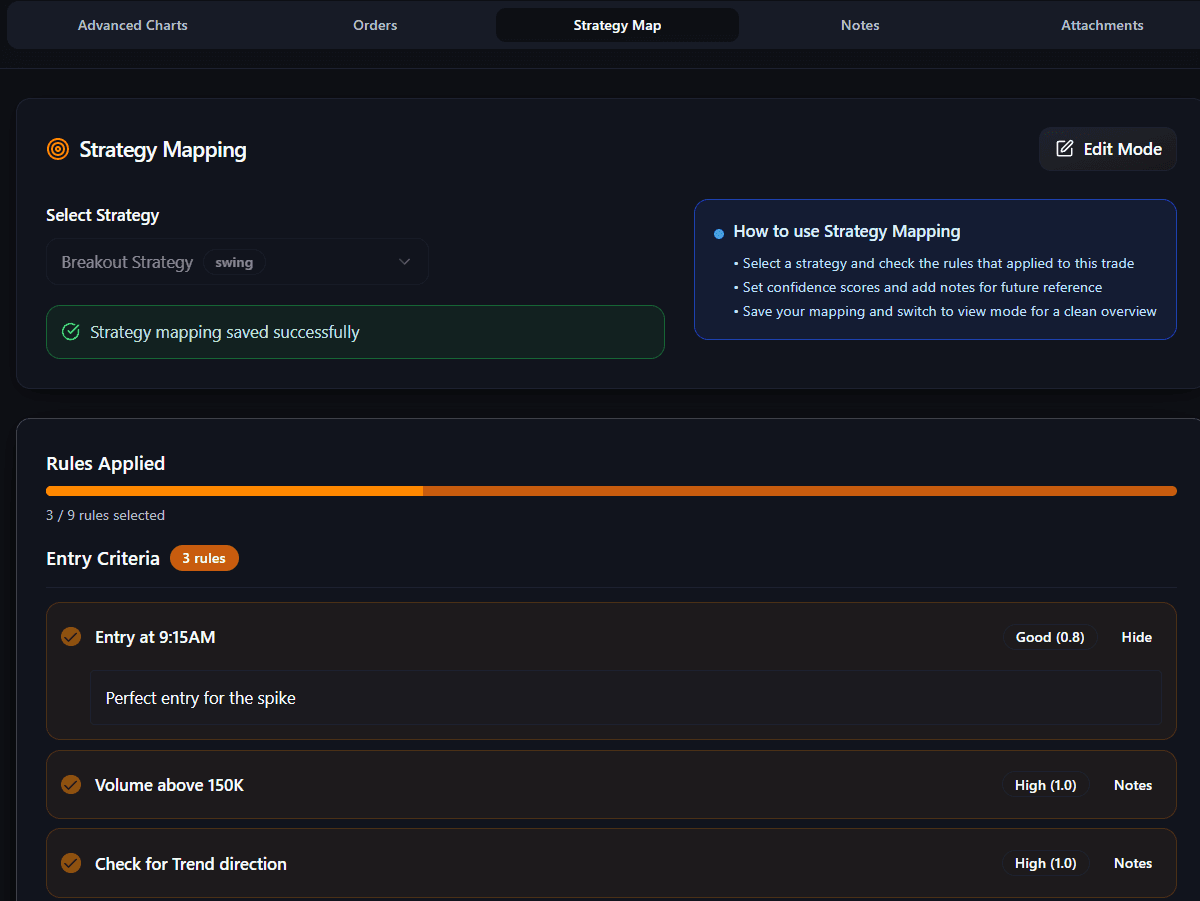
Guides and tools for technical analysis
- GuideHow to compare trading strategies fairlyCompare trading strategies on equal terms: same window, costs included, enough trades. Read expectancy, profit factor and drawdown side by side, then decide.
- GuideHow to use trade tags and dashboard metricsBuild a small, consistent set of trade tags, read tag performance by expectancy, and use dashboard widgets as quick checks before you open the full reports.
- GuideStrategy statistics: expectancy, profit factor and moreWork out expectancy and profit factor for any trading strategy, check the sample is big enough, and look past averages to drawdown, streaks and concentration.
- Free toolATR stop-loss calculatorSet a stop distance from current volatility.
- Free toolPivot point calculatorPivot, support and resistance levels from the previous session.
Other categories
All 370 terms, A to Z →Track it on your own trades
Connect your Indian broker and review every trade with tags, notes and per-strategy numbers.