Tradelyser Logo

Understand AI Trading Analytics Scores

What TradeLyser AI scores mean, how they are derived from your journal, and how to use them in review.

11 min read · Updated 2026-06-05 · Reviewed by TradeLyser Content Team (Practicing Indian market traders)

Key takeaways

  • Scores summarise patterns — verify against raw trades.
  • Never trade solely on an AI number.
  • Run data QA before trusting score moves.

AI analytics in trading journals promise speed: summarise weeks of behaviour in seconds, flag concentration risk, highlight deteriorating expectancy. The danger is treating a score like a signal. TradeLyser’s Elysia AI layer sits on top of your own trade and journal data — it does not see the market ahead of you. Understanding AI trading analytics scores means knowing what inputs they use, what statistical habits they approximate, where they fail, and how to fold them into a human review ritual that keeps accountability yours. This guide is that operating manual for Indian retail and active traders using TradeLyser.

What AI scores are in TradeLyser

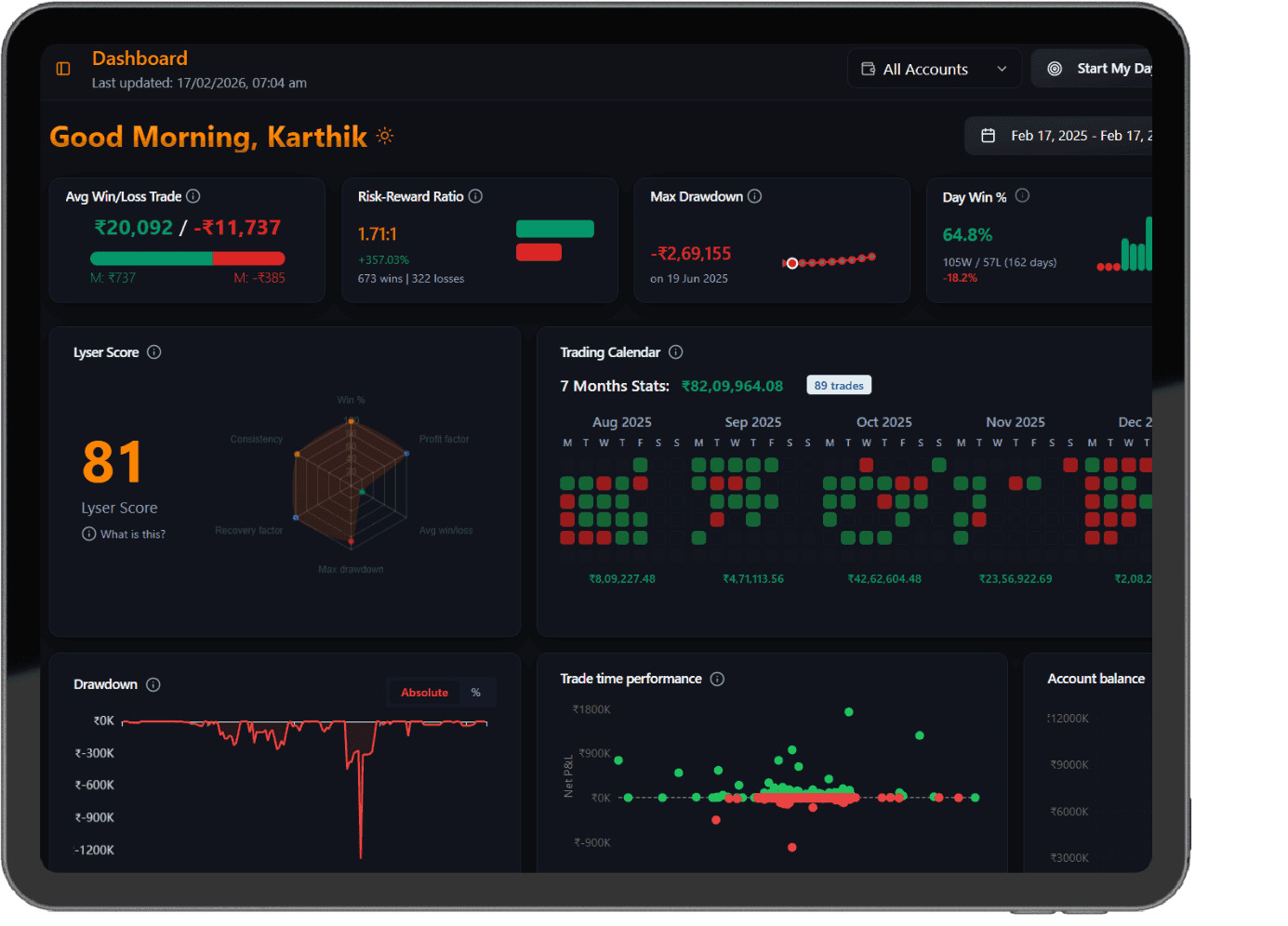
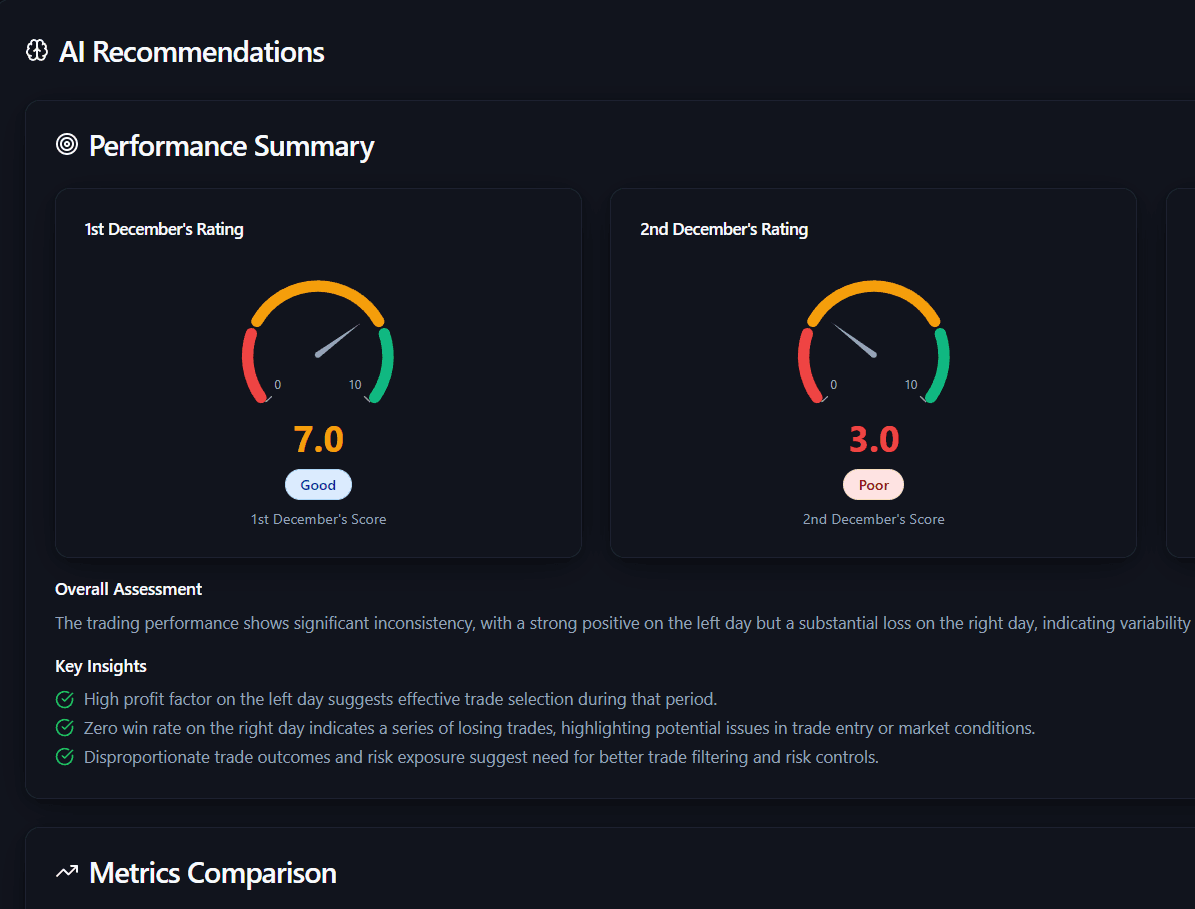
AI scores are compressed summaries of patterns in your historical trades and journal metadata: consistency, risk discipline proxies, concentration, recent trend in outcomes, and behavioural tags if you use them. They are not predictions of tomorrow’s Nifty direction. Think of them as triage labels on a hospital chart — they tell the nurse which room to visit first, not the final diagnosis.

Inputs the system can and cannot see

The model sees what you feed it: executed trades, tags, notes, grades, rule violations, time stamps, symbols, and derived metrics like win rate and drawdown. It does not see your unread chart markup, WhatsApp tip groups, or macro thesis you never logged. Garbage in, glossy summary out — tagging hygiene matters as much for AI as for reports.

It also cannot see future corporate actions unreflected in imports, or manual edits you forget. Reconcile broker data regularly.

Typical score components (conceptual)

  • Process adherence proxy — discipline tags, rule breaks, size vs plan.
  • Edge stability — rolling expectancy direction, profit factor drift.
  • Risk shape — drawdown depth, loss clustering, tail losses.
  • Concentration — symbol, sector, or single strategy dominating P&L.
  • Activity quality — overtrading spikes vs baseline frequency.

Exact weightings may evolve with product updates; treat labels as directional, not precise ordinals.

How to read a score change week over week

When a score drops, open three layers: data integrity (import gaps?), behaviour (violations up?), market (volatility regime shift?). When a score rises, verify it is not one outlier winner inflating rolling metrics. Never size up on score alone.

AI recommendations: safe usage protocol

Recommendations might suggest reducing size after loss clusters, pausing a symbol, or reviewing a strategy with decaying rolling expectancy. Protocol: (1) read recommendation, (2) open supporting trades, (3) accept or reject with written reason in journal, (4) at most one behavioural change per week. Rejected recommendations are valuable — they train your judgment.

Mentor mode and AI together

Mentors can use AI summaries as conversation starters with mentees, not verdicts. Share score trends plus raw discipline metrics. Students should arrive with their own one-change commitment; mentors critique process. Permissioned access docs cover setup; AI guide covers interpretation.

Hard limits: what AI must not do for you

  • Place or suggest specific live orders.
  • Replace statutory tax or compliance advice.
  • Guarantee future performance or “fix” negative expectancy magically.
  • Absolve you of rule breaks because “the score was high”.

Bias and overfitting risks

AI finds patterns in your past. If your past is mostly one bull-year momentum chase, summaries will sound brilliant until regime flips. Small samples produce confident-sounding noise. Seasoned traders distrust hero narratives from <50 trades.

Weekly workflow integrating AI scores

  • Monday pre-market: glance score trend, note alerts only — no rule changes.
  • Friday review: export trades, run checklist human-first.
  • Then open AI summary — mark one hypothesis to verify in data.
  • Verify in Strategy Board and discipline diary.
  • Write one change; ignore other AI bullets until next week.

AI vs traditional statistics

Statistics in reports are exact for defined windows; AI narratives connect dots across tags and text. Use statistics for decisions, AI for prioritisation. If narrative and table conflict, trust the table after data QA.

Privacy and data use mindset

Treat journal notes as sensitive. Avoid pasting third-party PII. Understand product privacy policy updates. Mentor sharing is opt-in permissioned.

When to ignore AI for a week

Ignore AI summaries when imports failed, after major settings changes mid-week, during deliberate strategy experiments you tagged as “research”, or when sample size per strategy is tiny. Fix data first.

TradeLyser product tie-in

Generate AI analytics from the in-app flow documented in help centre. Pair with reports, widgets, and journal compare views. Methodology page explains how insights fit the four-pillar system.

Score archetypes and what to do

High process / low P&L: keep rules, revisit setup edge. Low process / high P&L: shrink size immediately, journal violations. High concentration: cap symbol risk. High activity: enforce max trades. Map AI narrative to one of these archetypes before acting.

Educating yourself without over-trusting NLP

Natural language summaries can sound authoritative. Cross-check every sentence against sortable columns: trade count, net P&L, average hold time, violation count. If the sentence cannot be traced to a column, treat as speculation.

How AI features may evolve — your habits should not

Models and UI will change. The habit loop — human review first, AI second, one change weekly — should not. Build personal checklists in notebook that survive vendor updates.

Ethics and marketing realism

Do not advertise AI scores as proof of skill to recruit followers. Do not imply guaranteed outcomes. Use analytics to improve private process. Regulatory and platform rules still apply to what you publish.

Closing

AI trading analytics scores are a prioritisation layer, not an oracle. Your edge still lives in defined setups, disciplined size, and honest review. Use TradeLyser AI to see where to look, never to skip looking. This week: run your human review first, then read the AI summary, verify one claim in raw trades, and log accept/reject in your journal — that habit keeps technology in the right seat.

Regulatory and compliance note: AI output is not investment advice. Treat summaries as internal operations research. Do not market guaranteed outcomes to clients or social followers based on scores.

Imagine two traders with identical AI scores — one has clean tags and full imports, the other has messy data. The score means different things. Before bragging or panicking, run data QA: missing days, duplicate trades, wrong strategy tags on outliers. AI on dirty data is polished nonsense. QA checklist: trade count versus broker, net P&L versus contract note within tolerance, strategy tag coverage percent, journal non-empty percent on traded days. Only then interpret scores. This discipline will matter more as models improve because better models amplify input quality differences — clean traders pull further ahead, messy traders get confident wrong stories.

Schedule a quarterly “AI audit” afternoon: re-read personal AI policy, list three times you followed AI advice and three times you rejected it, note outcomes neutrally. Policies evolve; audits prevent drift into blind trust or blind rejection. Management stays management.

Twelve-week integration roadmap

Weeks 1–4: human review only, ignore scores. Weeks 5–8: read scores after review, verify one claim weekly. Weeks 9–12: optional one AI-suggested experiment with written accept/reject log. After week twelve, decide if AI saves time — if not, disable notifications and keep manual review; the product should serve you, not recruit you.

Extended governance: personal AI usage policy

Write a half-page AI policy for yourself: AI may suggest priorities; AI may not trigger trades; AI may not change risk limits without human written approval; weekly one verification task mandatory. Sign it digitally in your notebook. Re-read after drawdown weeks when temptation to outsource blame rises.

If mentoring others, prohibit students from citing AI scores as excuse for rule breaks — accountability stays human. Mentors review student verification logs, not just scores.

Re-evaluate policy when sample per strategy exceeds 200 trades — AI triage becomes more reliable, but never fully autonomous. Governance matures with sample size; autonomy should not.

Log every AI recommendation you rejected and review quarterly — if rejections cluster, either AI miscalibrated for your style or you resist feedback; both are learnings.

Combine AI summaries with voice debrief to mentor — send summary plus your one-change commitment; meetings shorten and sharpen.

Synthesis: AI is staff, not management. You remain management — hiring, firing, sizing, pausing. Scores are staff memos; you chair the meeting. Chairing means human review first, verification second, one decision third. TradeLyser builds staff memos from your data; garbage data produces eloquent garbage. Invest in data hygiene before demanding better AI. When staff memos disagree with your gut, trust tables. When tables disagree with broker reality, fix imports. When everything aligns, act on one change. This loop will still work when models upgrade because roles stay stable. Traders who outsource management to staff get replaced by markets quickly. Traders who manage staff well get calmer sessions and fewer surprise drawdowns. Write that sentence in your notebook today: I am management; AI is staff. Read it before every weekly review.

Staying human-centred as models improve

Models will get better at language; your advantage remains execution and risk culture. Invest learning hours in discipline and strategy clarity, not prompt hacking.

When new AI features ship, read release notes, test on historical weeks you know well, and compare narrative to memory — calibration exercise.

Do not let AI summaries replace mentor human conversation — use both; AI prep, human nuance.

If a score conflicts with mentor advice, bring data table to call — resolve with numbers.

Sleep, health, and screen time affect rule breaks more than any score — journal health tags if needed; AI may later surface them if you log honestly.

Year-end AI retrospective: export summaries per quarter, note where AI was right versus wrong about your behaviour, adjust personal AI policy accordingly. Technology learns your patterns; you must learn how to supervise technology.

Putting your AI policy into weekly practice

Teach a friend the management-versus-staff metaphor in five minutes; teaching clarifies your own policy. If you cannot explain when you will ignore AI, you do not yet have a policy — you have hope. Hope is not a workflow. Write the explanation, store it, revisit after drawdown when hope returns dressed as AI certainty.

Each Sunday, list three AI-suggested focus areas and mark which you will act on, defer, or reject. Deferred items need a date; rejected items need one sentence why. This log becomes training data for you — patterns in rejection reveal whether you distrust the model or whether the model misunderstands your niche.

Version logging and score regression checks

Log AI version or feature release date when a score jumps — product changes confound before behaviour changes do. Keep a simple table: date, release note, average score shift per strategy, your verdict (noise / useful / harmful). Without version context you will attribute product updates to personal failure or genius incorrectly.

Regression check quarterly: pick ten trades you know deeply and ask whether AI commentary matches your memory. Mismatches on obvious trades mean you should widen human review, not tighten trust. Matches on obvious trades do not prove AI is right on subtle trades — only that baseline alignment exists.

Why AI scores must not drive position size

Position size should flow from risk per trade, account heat, and strategy slot limits — never from a daily AI enthusiasm score. Scores summarize behaviour and data quality; they are not volatility forecasts. Traders who size up on green scores often discover the score lagged behaviour improvement already priced in.

Use scores instead to prioritize review order: low discipline or inconsistent tagging strategies get human time first. High scores with deteriorating expectancy get second — possible overfitting to recent wins. The queue is triage, not endorsement.

Mentors, students, and AI accountability

If you mentor, require students to paste AI summary plus their own one-paragraph disagreement before each call. Calls stay short and evidence-based. If you are the student, bring the disagreement paragraph even when you agree — it proves you read the output rather than rubber-stamping.

Bookmark this guide and revisit after major platform updates or after your first hundred tagged trades — context changes, policy should not drift silently.

This flagship AI guide anchors the ai-trading pillar — read after journaling and strategy guides so scores sit in correct context.

FAQ

Can AI scores predict tomorrow’s market?

No — they summarise your historical behaviour and outcomes, not future prices.

Glossary

Related guides

Start journaling with TradeLyser

Connect your broker, tag strategies, and review performance with AI-assisted insights.