Use AI Recommendations in Trading (Safely)
How to apply AI recommendations from your journal data while keeping human accountability.
8 min read · Updated 2026-06-05
Key takeaways
- Treat recommendations as hypotheses.
- Log whether you accepted or rejected each insight.
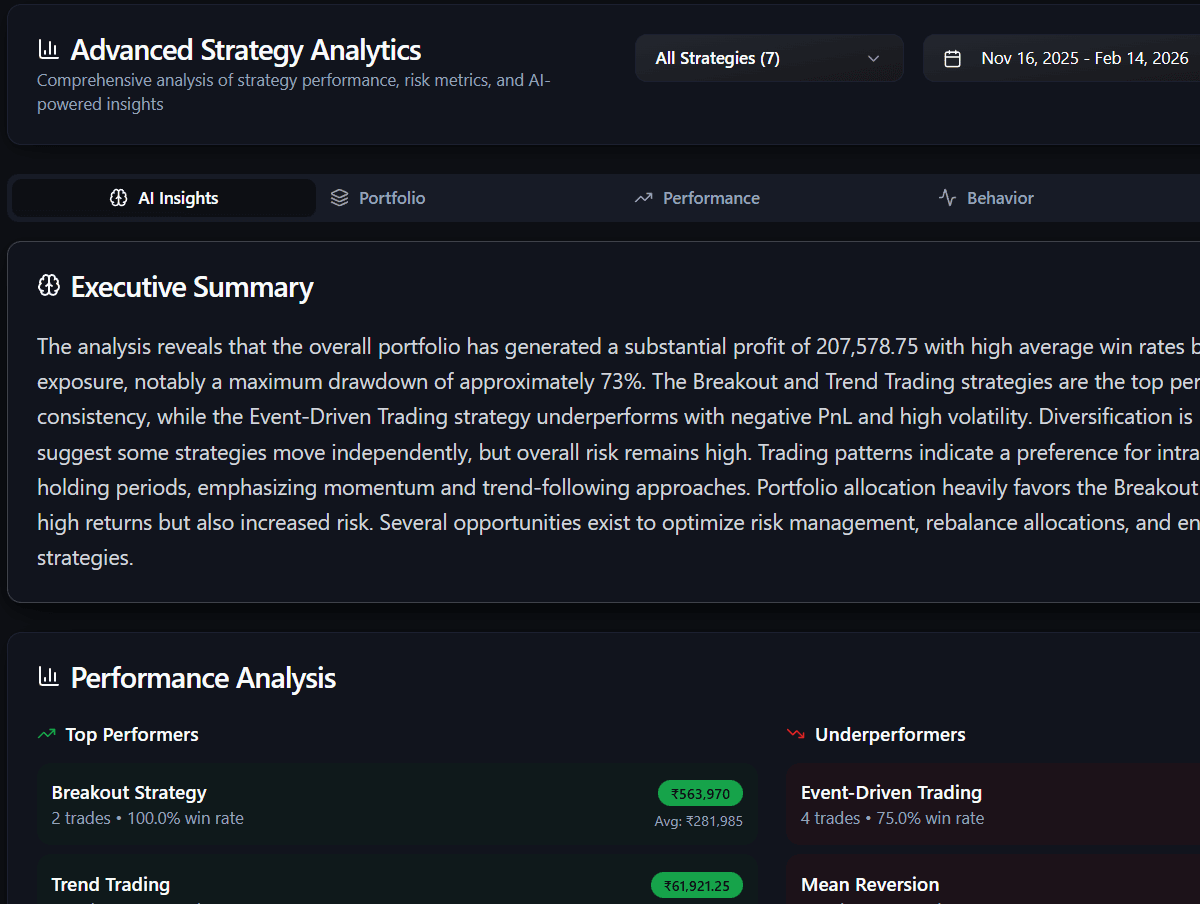
AI recommendations in a trading journal can feel like a senior trader whispering over your shoulder: flag overtrading after a loss cluster, warn that one symbol dominates P&L, or note that rolling expectancy on your core Nifty scalp is decaying. The danger is treating that whisper as an order. TradeLyser’s Elysia layer reads your own trades, tags, and journal metadata — it does not see tomorrow’s gap on Bank Nifty. Used well, recommendations shorten review time and surface patterns you would miss on a tired Sunday. Used poorly, they become excuses to chase fixes every session. This guide is a safe operating protocol for Indian retail and active traders applying AI recommendations while keeping human accountability.
What AI recommendations are — and are not
Recommendations are hypotheses generated from historical patterns: concentration risk, discipline proxies, rolling metric drift, activity spikes versus your baseline. They are not buy or sell signals. They do not replace statutory tax advice or SEBI compliance obligations. They summarise behaviour you already logged — garbage in, confident-sounding garbage out if tagging is sloppy.
Think of recommendations as triage labels on a hospital chart. They tell you which room to visit first in your review — Strategy Board stats, rule violations, symbol tables — not the final diagnosis. The insights methodology pillar (Insights pillar) positions AI as part of verification, not replacement for the weekly review (Weekly review).
Where recommendations appear in TradeLyser
Open AI analytics to see score trends and recommendation cards tied to your account data. They may reference strategy tags, symbol concentration, loss streaks, or journal discipline fields. Exact wording evolves with product updates — treat each item as a prompt to open supporting trades, not a command to change size before the open.
- Process adherence — rule breaks, size versus plan, revenge-tagged trades.
- Edge stability — rolling expectancy direction, profit factor drift.
- Risk shape — drawdown depth, loss clustering, tail losses on F&O books.
- Concentration — one stock, sector, or strategy dominating rupee P&L.
- Activity quality — trade count spikes versus your normal NSE session frequency.
Safe usage protocol
Every recommendation should pass a four-step gate before it changes behaviour:
- Read the recommendation in full — note which metric or tag triggered it.
- Open the supporting trades in Strategy Board (Strategy Board) or reports.
- Accept or reject with a written reason in your journal — one sentence is enough.
- Implement at most one behavioural change per week so causality stays traceable.
Rejected recommendations are valuable. They train judgment. If Elysia flags overtrading but you verify a planned expiry week with higher planned frequency, log “rejected — documented in pre-market plan”. Future reviews will show whether rejection was honest or defensive.
When accepting a recommendation makes sense
Accept when data verification confirms the pattern and the fix aligns with your written trading plan. Examples an Indian day trader might accept after verification:
- Symbol concentration — 70% of net P&L from one midcap while index scalps bleed; cap symbol risk.
- Deteriorating rolling expectancy on a tagged strategy across 20+ trades; pause per written policy.
- Loss cluster after size increase without journal note; revert to prior rupee risk until review.
- Rising count of untagged or “impulsive” trades; enforce tag-before-next-trade rule for one week.
Acceptance should produce a specific, measurable action — not vague “be more disciplined”. Good: “Max three Nifty futures trades before 11:00 until next Friday review.” Bad: “Try to focus more.”
When to reject or defer
Reject or defer when sample is too small, data is stale, or the recommendation ignores context you logged elsewhere.
- Fewer than 30 closed trades on the flagged strategy — wait for sample.
- Known import gap or broker sync delay that week — fix data first.
- Regime shift you already sized down for — recommendation lags your action.
- Recommendation conflicts with your mentor’s agreed focus for the fortnight — discuss, then decide.
Deferral is not denial. Log “deferred — recheck after sync fix” so the item resurfaces intentionally.
Data hygiene before you trust AI
AI sees what you feed it: executed trades, tags, notes, grades, timestamps, symbols, derived metrics. It does not see unread chart markup, WhatsApp tip groups, or macro thesis you never logged. Before acting on a recommendation shift, run a quick QA pass aligned with the journals pillar (Journals pillar):
- Reconcile broker imports — no missing sessions from the flagged window.
- Confirm strategy tags on every closed trade in scope.
- Check net P&L settings include brokerage and realistic slippage.
- Note any manual edits or corporate actions on cash equities.
Weekly workflow integrating recommendations
- Monday pre-market: glance AI trend and alerts only — no rule changes on commute.
- Friday review: export trades, run human-first checklist from weekly review (Weekly review).
- Then open AI recommendations — pick one hypothesis to verify in data.
- Verify in Strategy Board and discipline diary — not from the card alone.
- Write one accept/reject/defer decision; ignore other bullets until next week.
Human-first ordering matters. If you open AI before your own checklist, confirmation bias turns suggestions into gospel. Your journal is the system of record; AI is an assistant.
Tie recommendations to written rules
The rules methodology (Rules pillar) converts discipline into measurable fields — max daily loss in rupees, allowed setups, size formula. When a recommendation aligns with a rule you already broke, the fix is enforcement, not new complexity. When it suggests a rule you never wrote, add it to your plan formally before live testing — do not adopt ad hoc mid-session.
Hard limits: what AI must not do for you
- Place or suggest specific live orders or strike selections.
- Replace tax, compliance, or legal advice for Indian markets.
- Guarantee future performance or “fix” negative expectancy magically.
- Absolve rule breaks because “the score was high yesterday”.
- Justify revenge trading after a recommendation you rejected without logging why.
Overfitting and bull-market bias
AI finds patterns in your past. If your past is mostly one bull-year momentum chase on Nifty, summaries sound brilliant until regime flips to chop. Small samples produce confident noise. Seasoned traders distrust hero narratives from fewer than fifty trades. Season recommendations with regime tags in your journal so winter reviews interpret summer AI praise correctly.
How Elysia scores relate to recommendations
Scores summarise behaviour stability over a window; recommendations call out specific hypotheses when a threshold trips. A rising discipline proxy with flat P&L is different from a falling expectancy flag on a core tag — read which subsystem triggered the card before acting. Open AI analytics alongside Strategy Board: if the recommendation cites concentration, verify symbol table; if it cites activity spike, verify trade count versus your four-week baseline on NSE sessions.
Scores move slowly when tagging improves — expect lag after a hygiene week. Do not reject recommendations automatically because “you already fixed tags”; verify the flagged window excludes the fix week. Conversely, do not accept recommendations because the score badge turned green — confirm in closed trades.
Mentor plus AI: avoid double noise
When both mentor and AI flag the same pattern, prioritize the written rule it violates — enforcement first. When they conflict, log both views and defer size changes until manual verification. Mentors should ask students to paste accept/reject/defer decisions for AI items into shared notes so coaching stays about process, not competing narratives.
Indian book pitfalls for AI summaries
Mixed cash and F&O without product tags makes AI praise “consistent win rate” on a book that is really two different edges. Untagged expiry weeks make AI blame “overtrading” when the issue was structural session choice. STT-heavy scalping without net P&L settings flatters activity quality. Run QA from the data hygiene section before monthly AI review — especially after broker migrations or CSV imports.
Keep a simple AI decision log in journal notes: date, recommendation summary, accept/reject/defer, one-line reason. After eight weeks, read the log before enabling new AI features — you will see whether AI shortened review or became another noise channel.
Closing: you stay accountable
AI recommendations save time when they send you to the right trades faster. They destroy edge when they replace your checklist. Use AI analytics as a lens, Strategy Board as the evidence room, and your written rules as the constitution. One verified change per week beats five reactive tweaks before 9:15. That rhythm is how Indian traders keep Elysia useful without handing the steering wheel to a summary card.
First month with recommendations enabled
Week one: read only, verify nothing, log defer on all cards until tags are clean. Week two: verify top card only. Week three: first accept or reject with written reason. Week four: compare whether accepted changes improved discipline or expectancy — if not, tighten QA before next accept. Rushing adoption in week one trains obedience to noise.
Pair AI review with the same Friday slot as human checklist — never a second midweek session triggered by a push notification. Midweek AI reactions are how retail traders overfit to noise before the sample closes. Silence notifications if needed — your checklist is the schedule, not the app badge. Friday owns AI; Monday owns execution.
FAQ
How many AI-driven changes per week?
One — same rule as manual review. Multiple changes destroy attribution.
Glossary
Related guides
Start journaling with
TradeLyser
Connect your broker, tag strategies, and review performance with AI-assisted insights.