
Market Structure Glossary
How NSE and BSE are organised, how orders meet during a session, and the rules that can stop a stock from trading.
About market structure terms
Market structure covers how Indian markets are organised and how orders actually meet. It includes the exchanges (NSE and BSE), the main indices (Nifty 50 and Sensex), the regulator (SEBI) and the mechanics of a session: pre-open, the opening range, the order book, the bid-ask spread and liquidity. It also covers the rules that can stop trading in a stock, such as upper and lower circuits and the F&O ban list.
These terms explain many of the odd rows in a trade log. A wide spread in an illiquid option strike shows up as slippage. An overnight gap jumps over your stop. A stock locked at its upper circuit can leave a short seller with no one to buy from. FII and DII flows and the market cycle add context for trades held over several days. When a result looks strange, check the structure before the setup: the time of day, the liquidity of the contract, and any circuit or ban that applied that session.
Key terms in this category
Start with these, then use the full list below.
- In-depthLiquidityLiquidity is how easily you can buy or sell a quantity without moving the price much.Spread % = (Ask − Bid) ÷ Mid price × 100, where Mid = (Bid + Ask) ÷ 2
- In-depthBid-Ask SpreadThe bid-ask spread is the gap between the highest price a buyer is offering (the bid) and the lowest price a seller is asking (the ask).Spread = Ask − Bid; Spread % = (Ask − Bid) ÷ Mid price × 100, where Mid = (Ask + Bid) ÷ 2
- In-depthOpening RangeThe opening range is the high and low traded in a fixed window right after the open, commonly the first 5, 15 or 30 minutes after 9:15 on…Opening range = Highest high − Lowest low in the first N minutes; Midpoint = (Range high + Range low) ÷ 2
- In-depthGapA gap is a jump between one session’s close and the next session’s open, leaving a price range where no trading happened.Gap % = (Today’s open − Previous close) ÷ Previous close × 100
- In-depthLot SizeLot size is the fixed number of units in one derivative contract, set by the exchange, and F&O can only be traded in whole lots.Position value = Price × Lot size × Number of lots
- In-depthF&O BanAn F&O ban is the period when an NSE stock’s futures and options are restricted because open interest has crossed 95% of the market-wide…MWPL utilisation = Open interest across all futures and options of the stock ÷ MWPL × 100
All 42 market structure terms
- Bear MarketA bear market is a prolonged fall in prices, commonly defined as a decline of 20% or more from a recent high in a broad index.
- Bid-Ask SpreadThe bid-ask spread is the gap between the highest price a buyer is offering (the bid) and the lowest price a seller is asking (the ask).
- BSE (Bombay Stock Exchange)BSE, formerly the Bombay Stock Exchange, is India’s oldest stock exchange, set up in 1875, and runs the Sensex, a 30-stock index of large companies.
- Bull MarketA bull market is a sustained rise in prices, commonly marked by a gain of 20% or more from a recent low in a broad index, with higher highs and higher lows along the way.
- Buying PowerBuying power is the amount your broker lets you use to open new positions right now, after margin already blocked by open trades, collateral haircuts and today’s…
- CapitulationCapitulation is the late stage of a sharp decline when many holders give up at once and sell regardless of price, usually on very high volume and a spike in volatility.
- Circuit BreakerA circuit breaker is an exchange rule that halts or limits trading when prices move too far, too fast.
- ConsolidationConsolidation is a period in which price moves sideways within a defined range instead of trending, while buyers and sellers are roughly in balance.
- CorrectionA correction is a fall of about 10% to 20% from a recent high that interrupts, but does not necessarily end, a larger uptrend.
- Dark PoolA dark pool is a private trading venue where large orders are matched without being shown in a public order book before they trade.
- Demat AccountA demat (dematerialised) account holds your shares, ETFs and bonds in electronic form with a depository, NSDL or CDSL, through a depository participant such as your…
- Distribution PhaseThe distribution phase is a sideways range after a long advance in which large holders sell into demand, before the price starts a sustained decline.
- F&O BanAn F&O ban is the period when an NSE stock’s futures and options are restricted because open interest has crossed 95% of the market-wide position limit (MWPL).
- FII/DII FlowFII/DII flow is the daily net buying or selling of Indian equities by foreign institutional investors (now called foreign portfolio investors, FPIs) and domestic…
- LiquidityLiquidity is how easily you can buy or sell a quantity without moving the price much.
- Lot SizeLot size is the fixed number of units in one derivative contract, set by the exchange, and F&O can only be traded in whole lots.
- Lower CircuitA lower circuit is the lowest price a stock is allowed to trade at on a given day, set by the exchange as a percentage below the previous close.
- Market BreadthMarket breadth measures how many stocks are taking part in a market move, not just how far the index moved.
- Market CycleA market cycle is the repeating sequence of phases a market moves through: accumulation, an advance, distribution at the top and a decline.
- Market MakerA market maker is a participant that keeps quoting both a buy price (bid) and a sell price (ask) for an instrument, earning the gap between them and carrying the…
- Market ProfileMarket Profile is a way of charting a session by price and time: each 30-minute period gets a letter, and that letter is printed at every price traded during the period…
- Nifty 50Nifty 50 is NSE’s benchmark index of 50 large, actively traded Indian companies, weighted by free-float market capitalisation.
- NSE (National Stock Exchange)The National Stock Exchange of India (NSE) is one of India’s two main stock exchanges, alongside BSE, and the home of the Nifty 50 index and its futures and options.
- Opening RangeThe opening range is the high and low traded in a fixed window right after the open, commonly the first 5, 15 or 30 minutes after 9:15 on NSE.
- Order BookThe order book is the live list of buy orders (bids) and sell orders (asks) waiting at each price for an instrument, with the quantity at each level.
- Order FlowOrder flow is the stream of executed trades, and how aggressively they hit the bid or lifted the ask, read to judge whether buyers or sellers are pushing price in the…
- SEBISEBI, the Securities and Exchange Board of India, is the statutory regulator of India’s securities markets under the SEBI Act, 1992, overseeing exchanges, brokers…
- SensexSensex is BSE’s benchmark index of 30 large, actively traded Indian companies, weighted by free-float market capitalisation.
- Short InterestShort interest is the number of shares that have been sold short and not yet bought back, usually shown as a percentage of the free float.
- Short PositionA short position makes money when price falls: you sell first and buy back later at, you hope, a lower price.
- Short SqueezeA short squeeze is a sharp rise in price driven partly by short sellers buying back to cut their losses, with each round of covering pushing price higher.
- Smart MoneySmart money is a loose name for participants assumed to be better informed or better resourced than the average trader: mutual funds, insurers, foreign portfolio…
- Stock FloatA company’s float, or free float, is the part of its shares freely available to trade, after leaving out promoter and promoter-group holdings and other locked-in or…
- Stock SplitA stock split divides each existing share into more shares with a proportionally lower face value and price, so the value of your holding does not change.
The session in your own trades
The cross analysis report splits P&L by weekday and 15-minute slot, which shows whether the open, the midday lull or the last hour is where you make or lose money.
See analytics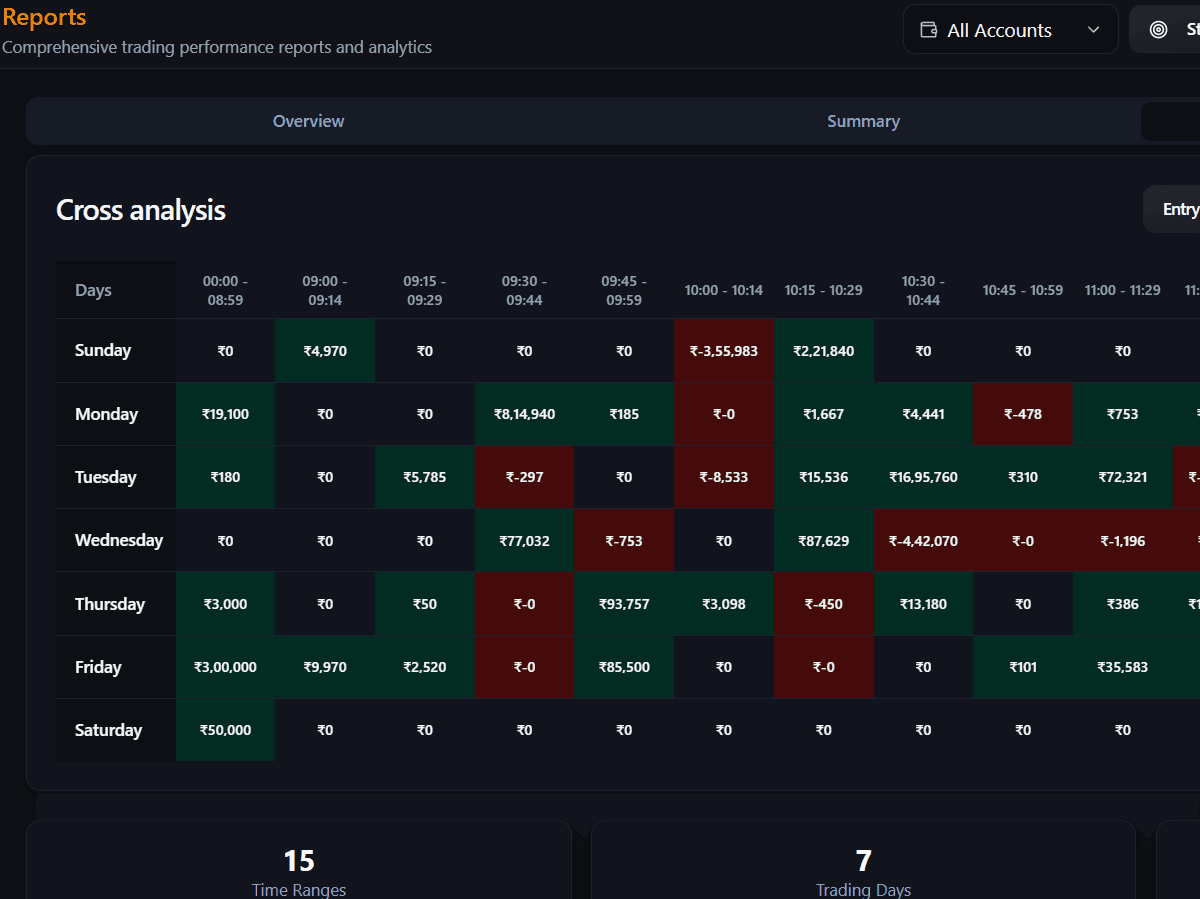
Guides and tools for market structure
- GuideHow to analyze P&L by period, time of day and symbolCompare trading P&L across fair, equal periods, find the sessions and weekdays that cost you money, and spot when one NSE symbol is carrying your whole month.
- GuideHow to keep a trading journal for NSE F&OWhat an options and futures trading journal in India should record: contract, lots, MIS or NRML, planned risk and net P&L after STT, plus expiry-day tags.
- GuideUsing a trading calendar for performance reviewUse a trading calendar in performance review to spot losses that cluster on expiry days, event days or after a losing streak, then set one rule for them.
- Free toolLot size referenceCurrent NSE lot sizes for index and stock derivatives.
Other categories
All 370 terms, A to Z →Track it on your own trades
Connect your Indian broker and review every trade with tags, notes and per-strategy numbers.